

Toni Black: Building Beyond Barriers
EXPERTS
We speak to Toni Black about resilience, identity and building House of Black — a studio rooted in story, strategy and strength.

Q: Toni, what a year! We at OLISE Magazine have loved seeing you shine in 2025, spanning WOW!house, multiple international projects, and now the launch of House of Black. When you look back on this chapter, which moments feel most defining for you, and why?
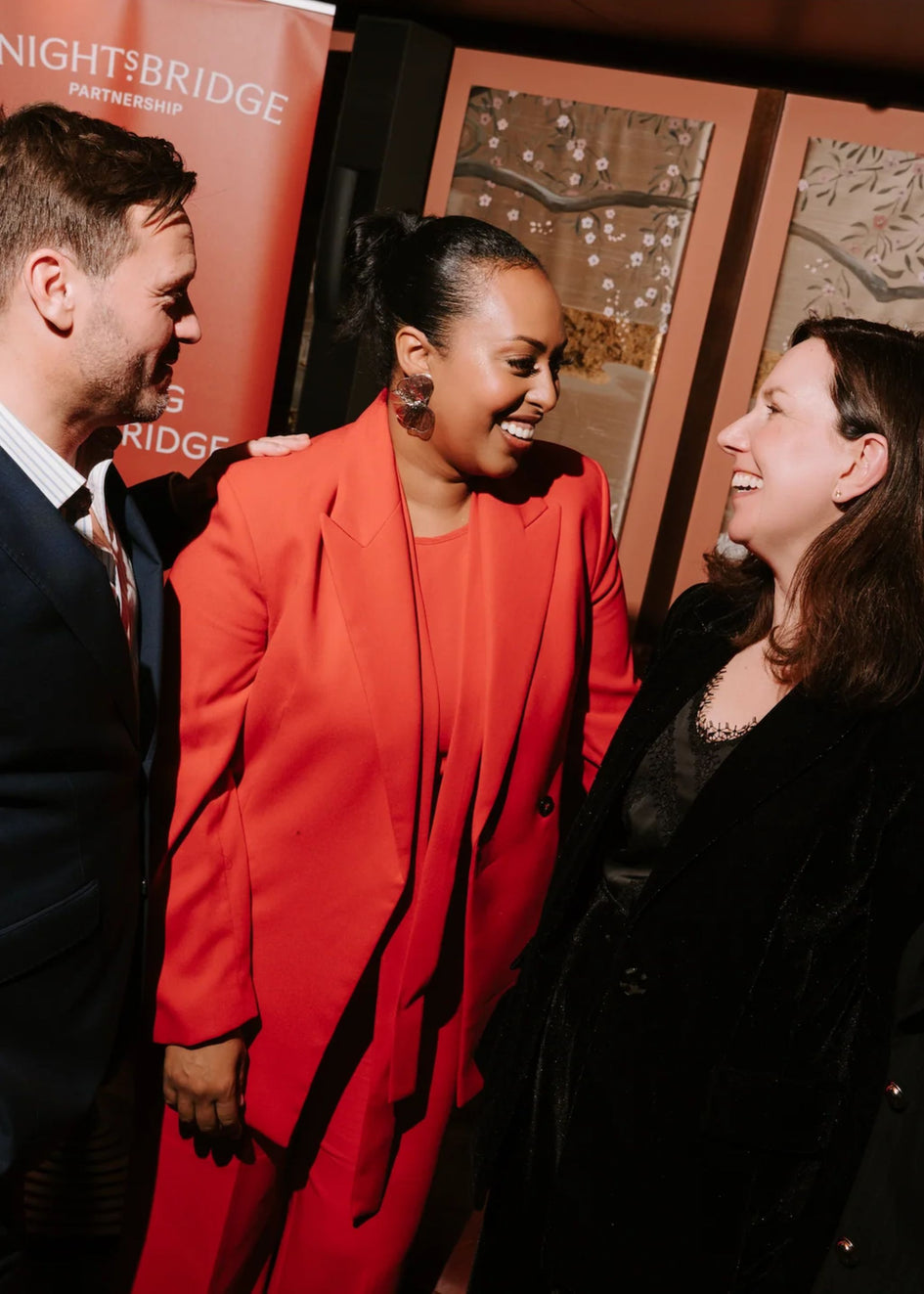
Hmm, good question. I think for me it has to be the launch, and more specifically the people who chose to take time out of their evenings to show up and be part of it. Time is so important, and I know how full life can be with work, family, and everything else pulling at you. So to have that level of support honestly meant the world.
I don’t want this to sound corny, but I really did feel special and very blessed. In one space I had my family, friends, long-standing working relationships, clients, and people from across the industry all coming together to support me. The room was full of energy, music, laughter, and a real sense of excitement.
Photo by Milo Brown
What also meant a lot was having my team there, genuinely excited to be part of it, backing me, believing in me, and wanting to be part of this next journey and new road we’re building together with House of Black.
People mean everything to me. Relationships mean everything. Without them, I truly believe we are nothing. Having all of those worlds come together in one moment, all part of the same journey, was incredibly special. And I know you’re probably going to ask why. The answer is simple. I love people, I value friendship, and I love my family. All of that defines who I am.
Q: Take us back to the very start of your journey into interior design. What first drew you to the industry, and how did those early experiences begin to shape the confident creative voice we see today?
It’s funny, this question was asked a couple of years back and I remember telling the story of how I used to sneak across Lambeth Bridge on my skates to the Tate when my mum said I was only allowed to stay in the local area. I still don’t know whether that makes me a slightly naughty child or just an inquisitive soul who fell in love with architecture and art very early on.
If I answer it from a young adult perspective, though, it’s simple. I'm a creative, it’s in my DNA. I always knew I would end up in a creative environment, it was just a matter of which sector. I took the more conventional route, I studied art and then completed a foundation at Camberwell School of Art, before deciding to specialise in interiors for my degree.
As for the confident creative voice you see today, that probably comes from somewhere else entirely. Art wasn’t actually my first love. Before that, I went to a performing arts school, The BRIT School, where I was acting, singing in a girl band, dancing, playing instruments, you name it. I was surrounded by performers, and I loved that environment. That sense of expression, confidence, and presence has always stayed with me.
Growing up in the 90s also played a huge part. As a first-generation child, with grandparents and parents who came over during the Windrush era, that time was very much about defining your voice and your identity. Being in a performing arts environment gave me the space to explore and express that.
It wasn’t all rosy, though. There were knockbacks early on, rejection, and moments that really tested me at the beginning of my career journey. But without sounding too cliché, those experiences shaped my resilience and helped build the confidence and strength I carry today, both creatively and personally.
Q: House of Black marks a new chapter, yet it builds on years of experience. As the sister company to Blacksheep, what inspired this evolved direction?
It honestly just felt like the right time. A few years back we reshaped the business and launched Blacksheep Collectives, which is where I became a shareholder and created the luxury and lifestyle division. That was a really important step and gave us the space to start exploring a more refined hospitality direction.
Then, a couple of years later, we sat down as directors and really reflected on the future. What did we want it to look like? Where did we want to be? For me, quite naturally, I wanted more autonomy and something I could truly grow, lead, and shape. That ambition was fully supported by my fellow directors.
What also became clear was that even with a separate division within Blacksheep, the lines were still blurred. There wasn’t enough clarity between the hospitality-led luxury work my team was doing and the broader scope of the original Blacksheep business. It became harder to clearly articulate that difference, both internally and externally.
Blacksheep will always be the founder’s baby, and rightly so. But I realised I needed a platform that clearly reflected my vision, my leadership, and the type of hospitality and lifestyle work I wanted to focus on. House of Black was born from that need for clarity, focus, and space to evolve, while still building on years of experience and shared history.


Q: You balance many roles, Leader, Designer, Wife, and most importantly Mother. What does balance really look like for you, and how do you protect your energy?
Balance… I don’t think it really exists, lol. Unless we’re talking about balancing scales, then maybe.
It isn’t easy, and I don’t believe there’s a magic wand for it either. For me, it’s about letting go of guilt and reminding myself that I’m just one person and I can’t do everything. Delegation really is key.
Photo by James Mcdonald
I’m also incredibly fortunate to have the most supportive family and true friends around me, and I genuinely give thanks for that. They keep me going, they keep me smiling, and I like to talk. A lot. Talking things out, releasing it, having a laugh when needed, and then moving on is how I protect my energy.
I don’t think I have one single source that keeps me going. I think it’s a mix of patience, perspective, and learning when to let go. Knowing when to pause, reset, and give myself a bit of grace. And honestly, some days, that’s what balance looks like for me.
Q: The creative industry can be demanding, particularly in leadership. What have been some of the biggest challenges you have faced, and how have you learned to navigate them?
This is definitely one of those questions that makes you stop and really think. I think one of the biggest challenges is wearing so many hats at once. You’re networking, engaging with new clients, leading a studio, and at the same time trying to stay current. And when I say current, I don’t mean trends. I mean technology, tools, and what’s available as things shift and move so quickly around us. The challenge is doing all of that without letting any of those plates drop.
I often think about that old saying, “it takes a village to raise a child”, and I apply that same thinking to my own growth as a leader. Behind every great leader is a fantastic team. I know I can’t do it all by myself, and I’m lucky to have a strong team that helps keep everything on track.
Learning how to delegate, not being afraid to ask for help, and leaning on others has been key. I also find real value in speaking with other designers and leaders from different agencies. It’s reassuring to know you’re not alone, and sometimes even a shared experience, a piece of advice, or a different perspective can make all the difference.

Q: When things feel overwhelming during a project, what helps you reset and move forward?
I try not to panic. I take some serious deep breaths and remind myself that whatever the situation is, it can’t kill me. Life is extremely short, and trust me, I’ve had my fair share of life stresses. Those experiences have shaped me and helped me realise that life, health, and happiness are the most important gifts we have. When I’m feeling overwhelmed, I try not to overthink things. And as you probably know by now, I like to talk. I talk it out, and then I go old school, pen to paper, and start mapping out the possibilities.
I don’t always find an immediate solution or outcome, but the process itself helps. It creates space, it slows things down, and it reminds me that most challenges are manageable when you take them one step at a time. Progress doesn’t always come from having all the answers, sometimes it comes from simply allowing yourself the clarity to move forward.
Q: Toni, you are known not only for your work but for your warmth and likeability. How important is human connection in the way you approach both design and business?
I’m a people person, I love being surrounded by people. In my early twenties I used to people-watch, not in a creepy or stalker way, lol, but because I was fascinated by how people interact with their spaces. There’s almost a science to what we do as designers.We can influence how people connect with each other just by changing a chair, a layout, or the way a space flows. I’ve always believed design should feel approachable and interactive. For me, that’s what sparks conversation, connection, and emotion.
When it comes to how I approach business, I’m honestly just myself. I don’t really know how to be anything else. I used to go to design shows, watch talks, and see these incredible people on stage and feel a sense of awe, and if I’m honest, sometimes a feeling of inferiority. I’d think, they sound so confident, so sure of themselves, am I like that?
But over time I realised it’s not about how someone sounds or how they present themselves. What really matters is what you bring to the table, your knowledge, your perspective, and your authenticity. Once I got over that initial sense of inferiority and stopped comparing myself to others, I found my own voice. And once I trusted that, everything started to fall into place, both in the way I design and the way I build relationships in business.
Q: Inspiration often comes from many places. If you could host a dinner with four people, past or present, who would be at the table, and why?
Maya Angelou would be number one, my hero above all. Through her words, she taught me that I don’t need to apologise for being a woman. That women can be strong, powerful, beautiful, and still feel pain, sadness, and vulnerability. She shaped the way I think and see myself. My teenage & early 20’s weren’t easy, her story and her ability to love herself through everything life threw at her felt phenomenal and deeply grounding for me.
Octavia Butler absolutely fascinates me. To me, she feels like a kind of prophet. She had this extraordinary ability to look at humanity as a whole and question where we are heading, particularly through the lens of power, gender, and society. Her work is fiction, but there is so much truth embedded in it that it still feels incredibly relevant today.
Margaret Atwood shares that same quality. Both she and Octavia Butler have this rare gift of almost forecasting society, especially when it comes to women, autonomy, and control. Their writing makes you pause, reflect, and question the world around you in a way that stays with you long after you’ve finished the book.
And finally, Georgia O’Keeffe, one of my favourite artists of all time. I see her as a real light rebel of her era. I would love to talk to her about life, her time, and her courage. The way she painted the female form, often interpreted through flowers, turning anatomy into something powerful and beautiful, at a time when women didn’t always have a strong voice, feels quietly radical. Whether intentional or not, her work opened conversations and challenged perspectives, and that’s something I deeply admire.
Q: When you are working or creating, what kind of environment helps you feel at your best? Do you prefer music playing, quiet focus, natural light, being outdoors, or something else entirely?
If I really need to focus, it’s me at home with a cup of fresh peppermint tea and a slice of lemon, soft jazz playing in the background, and lots of natural light. That’s my calm, reset space where I can properly think.
But when it comes to the creative side, it’s a different energy altogether. I’m very old school, pen/pencil on paper, now replaced by a stylus and an iPad, surrounded by other creative minds. Upbeat music, good lighting, laughter, and a sense of ease.
I don’t think the design process always has to be serious. I really love that first initial moment of a project, when you can be free to explore, play, and create without pressure. That’s when the best ideas tend to appear.

Q: And finally Toni, as you look ahead what excites you most about the next chapter of your life and career?
Like everyone, of course I hope to build a successful company that works on incredible projects around the world and is financially strong but that’s only part of it.
What really excites me is the journey itself. Continuing to grow as a person, learning new skills, meeting new people, and staying curious. Being present enough to enjoy the moments in between, not just the milestones.
And if along the way I can create spaces that people genuinely connect with, spaces that spark feeling, conversation, and memory, then that feels incredibly meaningful to me.
The possibility of what House of Black can become, and the life that grows alongside it, is what excites me about this next chapter.


